What Was the First Peice of Art Uploaded to Deventart

The earliest known surviving product of Nicéphore Niépce's heliography process, 1825. It is an ink on paper print and reproduces a 17th-century Flemish engraving showing a human leading a horse.


A modern-day photograph of an Icelandic landscape, captured on a personal photographic camera
A photo (as well known as a photo, epitome, or flick) is an image created by light falling on a photosensitive surface, ordinarily photographic film or an electronic image sensor, such as a CCD or a CMOS flake. Most photographs are now created using a smartphone/camera, which uses a lens to focus the scene's visible wavelengths of light into a reproduction of what the human being eye would see. The process and practise of creating such images is called photography.
Etymology [edit]
The discussion photograph was coined in 1839 by Sir John Herschel and is based on the Greek φῶς (phos), meaning "light," and γραφή (graphê), significant "drawing, writing," together meaning "cartoon with calorie-free."[1]
History [edit]
The kickoff permanent photo, a contact-exposed copy of an engraving, was made in 1822 using the bitumen-based "heliography" process developed by Nicéphore Niépce. The start photographs of a existent-world scene, made using a camera obscura, followed a few years later at Le Gras, France, in 1826, but Niépce's process was non sensitive enough to be practical for that application: a camera exposure lasting for hours or days was required.[2] In 1829 Niépce entered into a partnership with Louis Daguerre and the two collaborated to work out a similar but more sensitive and otherwise improved process.

After Niépce's death in 1833 Daguerre concentrated on silver halide-based alternatives. He exposed a silver-plated copper sheet to iodine vapor, creating a layer of low-cal-sensitive silver iodide; exposed it in the camera for a few minutes; developed the resulting invisible latent epitome to visibility with mercury fumes; then bathed the plate in a hot salt solution to remove the remaining silver iodide, making the results lite-fast. He named this first practical process for making photographs with a camera the daguerreotype, afterwards himself. Its being was announced to the world on 7 January 1839 merely working details were not fabricated public until 19 August. Other inventors soon made improvements which reduced the required exposure time from a few minutes to a few seconds, making portrait photography truly practical and widely popular.
The daguerreotype had shortcomings, notably the fragility of the mirror-like image surface and the particular viewing conditions required to see the epitome properly. Each was a unique opaque positive that could but be duplicated past copying it with a camera. Inventors gear up nigh working out improved processes that would be more practical. By the cease of the 1850s the daguerreotype had been replaced by the less expensive and more than easily viewed ambrotype and tintype, which fabricated use of the recently introduced collodion process. Glass plate collodion negatives used to brand prints on albumen newspaper soon became the preferred photographic method and held that position for many years, fifty-fifty after the introduction of the more user-friendly gelatin process in 1871. Refinements of the gelatin procedure have remained the principal black-and-white photographic process to this day, differing primarily in the sensitivity of the emulsion and the support fabric used, which was originally drinking glass, and so a variety of flexible plastic films, along with diverse types of paper for the final prints.
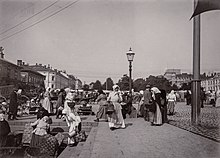
Color photography is near every bit old as black-and-white, with early on experiments including John Herschel's Anthotype prints in 1842, the pioneering work of Louis Ducos du Hauron in the 1860s, and the Lippmann procedure unveiled in 1891, but for many years color photography remained piffling more than a laboratory curiosity. Information technology first became a widespread commercial reality with the introduction of Autochrome plates in 1907, but the plates were very expensive and not suitable for casual snapshot-taking with hand-held cameras. The mid-1930s saw the introduction of Kodachrome and Agfacolor Neu, the offset like shooting fish in a barrel-to-use colour films of the mod multi-layer chromogenic blazon. These early processes produced transparencies for use in slide projectors and viewing devices, but colour prints became increasingly popular subsequently the introduction of chromogenic colour print newspaper in the 1940s. The needs of the move moving-picture show industry generated a number of special processes and systems, possibly the best-known existence the now-obsolete iii-strip Technicolor process.
Types of photographs [edit]
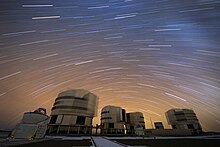
Non-digital photographs are produced with a two-step chemical process. In the two-step process the light-sensitive movie captures a negative image (colors and lights/darks are inverted). To produce a positive epitome, the negative is most commonly transferred ('printed') onto photographic newspaper. Press the negative onto transparent pic stock is used to industry movement picture films.
Alternatively, the pic is processed to capsize the negative image, yielding positive transparencies. Such positive images are usually mounted in frames, called slides. Before recent advances in digital photography, transparencies were widely used by professionals because of their sharpness and accuracy of color rendition. About photographs published in magazines were taken on colour transparency moving-picture show.
Originally, all photographs were monochromatic or hand-painted in color. Although methods for developing colour photos were available every bit early equally 1861, they did not become widely available until the 1940s or 1950s, and even and then, until the 1960s most photographs were taken in black and white. Since then, color photography has dominated popular photography, although black and white is still used, being easier to develop than colour.
Panoramic format images can be taken with cameras like the Hasselblad Xpan on standard film. Since the 1990s, panoramic photos accept been available on the Advanced Photo System (APS) picture. APS was developed past several of the major film manufacturers to provide a film with different formats and computerized options bachelor, though APS panoramas were created using a mask in panorama-capable cameras, far less desirable than a true panoramic camera, which achieves its issue through a wider film format. APS has become less popular and has been discontinued.
The advent of the microcomputer and digital photography has led to the rise of digital prints. These prints are created from stored graphic formats such as JPEG, TIFF, and RAW. The types of printers used include inkjet printers, dye-sublimation printer, laser printers, and thermal printers. Inkjet prints are sometimes given the coined proper name "Giclée".
The Web has been a pop medium for storing and sharing photos ever since the get-go photograph was published on the web by Tim Berners-Lee in 1992 (an prototype of the CERN house band Les Horribles Cernettes). Today pop sites such as Flickr, PhotoBucket and 500px are used by millions of people to share their pictures.
Preservation [edit]
Paper folders [edit]
Platonic photograph storage involves placing each photo in an private folder synthetic from buffered, or acid-free paper.[four] Buffered paper folders are especially recommended in cases when a photograph was previously mounted onto poor quality material or using an agglutinative that will lead to fifty-fifty more than acid cosmos.[v] Store photographs measuring 8x10 inches or smaller vertically along the longer border of the photo in the buffered paper folder, inside a larger archival box, and label each binder with relevant data to identify it. The rigid nature of the folder protects the photo from slumping or creasing, as long equally the box is not packed likewise tightly or under filled. Binder larger photos or brittle photos stacked apartment inside archival boxes with other materials of comparable size.[6]
Polyester enclosures [edit]
The most stable of plastics used in photo preservation, polyester, does not generate any harmful chemic elements, nor does it accept any capability to blot acids generated by the photograph itself. Polyester sleeves and encapsulation have been praised for their ability to protect the photo from humidity and ecology pollution, slowing the reaction between the item and the atmosphere. This is true, however the polyester just as frequently traps these elements adjacent to the material it is intended to protect. This is especially risky in a storage environment that experiences drastic fluctuations in humidity or temperature, leading to ferrotyping, or sticking of the photograph to the plastic.[4] Photographs sleeved or encapsulated in polyester cannot be stored vertically in boxes because they will slide down next to each other inside the box, angle and folding, nor tin the archivist write directly onto the polyester to identify the photograph. Therefore, it is necessary to either stack polyester protected photographs horizontally inside a box, or bind them in a three ring binder. Stacking the photos horizontally inside a flat box will greatly reduce ease of access, and binders exit three sides of the photo exposed to the furnishings of light[7] and practice not support the photograph evenly on both sides, leading to slumping and bending within the binder. The plastic used for enclosures has been manufactured to be as frictionless as possible to forbid scratching photos during insertion to the sleeves. Unfortunately, the glace nature of the enclosure generates a build-upwardly of static electricity, which attracts grit and lint particles. The static can attract the dust to the within of the sleeve, equally well, where it can scratch the photograph.[iv] Likewise, these components that assistance in insertion of the photo, referred to as sideslip agents, can intermission down and transfer from the plastic to the photograph, where they eolith as an oily motion picture, attracting further lint and dust. At this time, in that location is no exam to evaluate the long-term furnishings of these components on photographs. In addition, the plastic sleeves can develop kinks or creases in the surface, which volition scratch away at the emulsion during handling.[seven]
Handling and care [edit]
It is best to leave photographs lying flat on the table when viewing them. Do non pick information technology up from a corner, or even from two sides and hold it at eye level. Every time the photograph bends, even a piffling, this can suspension down the emulsion.[viii] The very nature of enclosing a photograph in plastic encourages users to pick it upwardly; users tend to handle plastic enclosed photographs less gently than non-enclosed photographs, simply because they feel the plastic enclosure makes the photograph impervious to all mishandling. As long as a photo is in its folder, there is no need to impact it; simply remove the folder from the box, lay information technology flat on the table, and open the folder. If for some reason the researcher or archivist does need to handle the actual photo, perhaps to examine the verso for writing, he or she tin can use gloves if in that location appears to be a hazard from oils or dirt on the easily.
Myths and beliefs [edit]
Because daguerreotypes were rendered on a mirrored surface, many spiritualists too became practitioners of the new art class. Spiritualists would merits that the human image on the mirrored surface was akin to looking into 1's soul. The spiritualists also believed that it would open their souls and let demons in. Among Muslims, it is makruh (disliked) to perform salah (worship) in a place decorated with photographs.[9] Photography and darkroom anomalies and artifacts sometimes lead viewers to believe that spirits or demons accept been captured in photos.[ten]
Legality [edit]
The production or distribution of sure types of photograph has been forbidden nether modern laws, such as those of government buildings,[eleven] highly classified regions,[12] private property, copyrighted works,[xiii] [14] children's ballocks,[15] child pornography and less commonly pornography overall.[16] These laws vary greatly between jurisdictions.
See also [edit]
- Aerial photography
- Archival science
- Cinematographer
- Conservation and restoration of photographs
- Hand-colouring of photographs
- List of largest photographs
- Listing of nigh expensive photographs
- Pseudo-photograph
- Slide show
References [edit]
- ^ "Online Etymology Lexicon". Retrieved sixteen January 2017.
- ^ "The First Photograph - Heliography". Archived from the original on half-dozen Oct 2009. Retrieved 29 September 2009.
from Helmut Gernsheim'south article, "The 150th Anniversary of Photography," in History of Photography Vol. I, No. 1, January 1977: ... In 1822, Niépce coated a glass plate ... The sunlight passing through ... This first permanent example ... was destroyed ... some years later.
- ^ "A Stream of Stars over Paranal". ESO Movie of the Week . Retrieved 27 May 2014.
- ^ a b c "5.6 Storage Enclosures for Photographic Materials". Retrieved xvi Jan 2017.
- ^ Norris, Debbie Hess. "Caring for Your Photographic Collections." Library of Congress. ix Feb. 2008, LOC.gov
- ^ "How Should I Store my Photographic Prints?" Preservation and Archives Professionals. The National Archives and Records Administration. 9 February 2008, Archives.gov
- ^ a b International Organisation for Standardization. ISO 18902:2001(Eastward). Geneva, Switzerland: ISO Office, 2007.
- ^ Baggett, James Fifty. "Handle with Care: Photos." Alabama Librarian. 54.1 (2004): 5.
- ^ Rizvi, Sayyid. Your Questions Answered. p. 32.
- ^ "Photos That AREN'T Paranormal". thoughtco.com.
- ^ "Hong Kong e-Legislation". Authorities of Hong Kong. Retrieved 20 September 2017.
- ^ Masco, Joseph. ""Sensitive merely Unclassified": Secrecy and the Counterterrorist State." Public Culture 22.iii (2010): 433-463.
- ^ Deazley, Ronan (2010). "Photography, copyright, and the Southward Kensington experiment". Intellectual Property Quarterly. 3: 293–311.
- ^ Turnbull, Bruce H. "Of import legal developments regarding protection of copyrighted content confronting unauthorized copying." IEEE Communications Magazine 39.eight (2001): 92-100.
- ^ Slane, Andrea. "From scanning to sexting: The telescopic of protection of dignity-based privacy in Canadian child pornography law." Osgoode Hall Police Journal 48 (2010): 543.
- ^ Taylor, Max; Quayle, Ethel; Kingdom of the netherlands, Gemma (2001). "Child pornography, the Internet and offending". ISUMA - the Canadian Journal of Policy Enquiry. 2 (2): 94–100.
External links [edit]
Source: https://en.wikipedia.org/wiki/Photograph
0 Response to "What Was the First Peice of Art Uploaded to Deventart"
Post a Comment