Which Art Historian Exposed as Soviet Spy and Strippedofknighthood
| Anthony Blunt | |
|---|---|
 | |
| Born | Anthony Frederick Blunt (1907-09-26)26 September 1907 Bournemouth, Hampshire, England |
| Died | 26 March 1983(1983-03-26) (aged 75) Westminster, London, England |
| Burial identify | Putney Vale Cemetery and Crematorium, London, England |
| Alma mater | Trinity College, Cambridge |
| Occupation | Art historian, professor, writer, spy |
| Espionage activity | |
| Allegiance |  Soviet Union Soviet Union |
| Codenames |
|
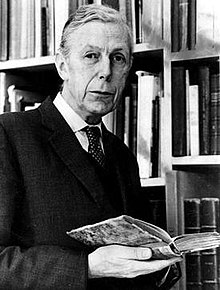
Anthony Frederick Blunt (26 September 1907 – 26 March 1983),[4] styled Sir Anthony Blunt KCVO from 1956 to November 1979, was a leading British art historian who in 1964, afterward being offered immunity from prosecution, confessed to having been a spy for the Soviet Union.
Edgeless was considered to exist the "fourth man" of the Cambridge Five, a grouping of Cambridge-educated spies working for the Soviet Spousal relationship from some fourth dimension in the 1930s to at to the lowest degree the early 1950s.[five] He was the fourth discovered, with John Cairncross yet to exist revealed. The height of his espionage action was during Globe War II, when he passed intelligence on Wehrmacht plans that the British government had decided to withhold from its ally. His confession, a closely guarded hole-and-corner for years, was revealed publicly by Prime Minister Margaret Thatcher in Nov 1979. He was stripped of his knighthood immediately thereafter.
Blunt was professor of art history at the University of London, director of the Courtauld Establish of Fine art, and Surveyor of the Queen's Pictures. His 1967 monograph on the French Baroque painter Nicolas Poussin is however widely regarded equally a watershed book in art history.[6] His teaching text and reference piece of work Fine art and Compages in French republic 1500–1700, offset published in 1953, reached its fifth edition in a slightly revised version past Richard Beresford in 1999, when it was nonetheless considered the best business relationship of the bailiwick.[7]
Early on life [edit]
Edgeless was born in Bournemouth, in Hampshire at that time but now in Dorset, the tertiary and youngest son of a vicar, the Revd (Arthur) Stanley Vaughan Blunt (1870–1929), and his wife, Hilda Violet (1880–1969), daughter of Henry Master of the Madras ceremonious service.[5]
His siblings included the writer Wilfrid Jasper Walter Edgeless and numismatist Christopher Evelyn Edgeless. The poet Wilfrid Scawen Edgeless was a great-uncle.[5]
He was also a tertiary cousin of Queen Elizabeth the Queen Mother: his female parent was the second cousin of Elizabeth's male parent Claude Bowes-Lyon, 14th Earl of Strathmore and Kinghorne. He was fourth cousin in one case removed of Sir Oswald Ernald Mosley (1896–1980) 6th Baronet of Ancoat, leader of the British Union of Fascists, both being descended from John Parker Mosley (1722–1798).
Blunt'southward father, a vicar, was assigned to Paris with the British embassy chapel, and moved his family to the French capital for several years during Anthony's childhood. The immature Anthony became fluent in French and experienced intensely the artistic civilization available to him there, stimulating an interest which lasted a lifetime and formed the ground for his later career.[8]
He was educated at Marlborough Higher, a boys' public schoolhouse in Marlborough, Wiltshire. At Marlborough, Blunt joined the college'due south secret 'Guild of Amici',[9] in which he was a gimmicky of Louis MacNeice (whose unfinished autobiography The Strings Are Faux contains numerous references to Edgeless), John Betjeman and Graham Shepard. He was remembered by historian John Edward Bowle, a year alee of Blunt at Marlborough, as "an intellectual prig, besides preoccupied with the realm of ideas". Bowle thought Blunt had "besides much ink in his veins and belonged to a world of rather prissy, cold-blooded, bookish puritanism".[eight]
In 1928 Blunt founded a political mag, Venture, of which the contributors were left-wing writers.[10]
Cambridge University [edit]
Blunt won a scholarship in mathematics to Trinity College, Cambridge. At that time, scholars at Cambridge University were immune to skip Role I of the Tripos examinations and complete Part II in two years. Nevertheless, they could not earn a degree in less than three years,[11] hence Edgeless spent iv years at Trinity and switched to Modern Languages, eventually graduating in 1930 with a showtime class caste. He taught French at Cambridge and became a Fellow of Trinity College in 1932. His graduate enquiry was in French art history and he travelled frequently to continental Europe in connection with his studies.[8]
Like Guy Burgess, Blunt was known to be homosexual,[12] which was a criminal offence at the fourth dimension in U.k.. Both were members of the Cambridge Apostles (also known equally the Conversazione Club), a clandestine Cambridge discussion group of 12 undergraduates, mostly from Trinity and King's Colleges who considered themselves to be the brightest minds. Through the Apostles, he met the future poet Julian Bell (son of Vanessa Bell) and took him every bit a lover.[thirteen] Many others were homosexual and also Marxist at that time. Amongst other members were Victor Rothschild and the American Michael Whitney Straight, the latter also later suspected of beingness office of the Cambridge spy ring.[14] Rothschild subsequently worked for MI5[15] and likewise gave Blunt £100 to purchase the painting Eliezar and Rebecca past Nicolas Poussin.[16] The painting was sold by Blunt's executors in 1985 for £100,000 (totalling £192,500 with tax remission[17]) and is now in Cambridge University's Fitzwilliam Museum.[18]
Recruitment to Soviet espionage [edit]
There are numerous versions of how Blunt was recruited to the NKVD. Every bit a Cambridge don, Blunt visited the Soviet Wedlock in 1933, and was perhaps recruited in 1934. In a press conference, Blunt claimed that Guy Burgess recruited him as a spy.[nineteen] The historian Geoff Andrews writes that he was "recruited between 1935 and 1936",[twenty] while his biographer Miranda Carter says that information technology was in January 1937 that Burgess introduced Edgeless to his Soviet recruiter, Arnold Deutsch.[21] Shortly subsequently meeting Deutsch, writes Carter, Blunt became a Soviet "talent lookout man" and was given the NKVD code name 'Tony'.[1] Blunt may have identified Burgess, Kim Philby, Donald Maclean, John Cairncross and Michael Straight – all undergraduates at Trinity College (except Maclean at the neighbouring Trinity Hall), a few years younger than he – as potential spies for the Soviets.[22]
Edgeless said in his public confession that it was Burgess who converted him to the Soviet cause, later on both had left Cambridge.[23] Both were members of the Cambridge Apostles, and Burgess could have recruited Blunt or vice versa either at Cambridge Academy or later when both worked for British intelligence.
Joining MI5 [edit]
With the invasion of Poland by German and Soviet forces, Blunt joined the British Regular army in 1939. During the Phoney War he served in France in the Intelligence Corps. When the Wehrmacht collection British forces back to Dunkirk in May 1940, he was function of the Dunkirk evacuation. During that same year he was recruited to MI5, the Security Service.[8] Before the war, MI5 employed mostly one-time members of the Indian Purple Police.[24]
In MI5, Edgeless began passing the results of Ultra intelligence (from decrypted Enigma intercepts of Wehrmacht radio traffic on the Eastern Front) to the Soviets, equally well as details of High german spy rings operating in the Soviet Union. Ultra was primarily working on the Kriegsmarine naval codes, which eventually helped win the Boxing of the Atlantic, but as the war progressed Wehrmacht regular army codes were also broken. Sensitive receivers could pick up transmissions, relating to German war plans, from Berlin. There was bully gamble that, if the Germans discovered their codes had been compromised, they would change the settings of the Enigma wheels, blinding the codebreakers.
Full details of the unabridged Operation Ultra were fully known by only 4 people, only i of whom routinely worked at Bletchley Park. Broadcasting of Ultra information did not follow usual intelligence protocol but maintained its own communications channels. Military intelligence officers gave intercepts to Ultra liaisons, who in plow forwarded the intercepts to Bletchley Park. Data from decoded messages was and then passed back to military leaders through the aforementioned channels. Thus, each link in the communications chain knew but ane particular chore and non the overall Ultra details. Nobody outside Bletchley Park knew the source.[25]
John Cairncross, another of the Cambridge Five, was posted from MI6 to piece of work at Bletchley Park. Blunt admitted to recruiting Cairncross and may well take been the cut-out between Cairncross and the Soviet contacts. For although the Soviet Union was now an ally, Russians were not trusted. Some information concerned German preparations and detailed plans for the Battle of Kursk, the terminal major German language offensive on the Eastern Front. Malcolm Muggeridge, himself a wartime British agent, recalls meeting Kim Philby and Victor Rothschild, a friend of Blunt since Trinity Higher, Cambridge. He reported that at the Paris meeting in late 1955 Rothschild argued that much more than Ultra cloth should have been given to Stalin. For once, Philby reportedly dropped his reserve, and agreed.[26]
During the war, Edgeless attained the rank of major.[8] After WWII, Blunt's espionage action macerated, just he retained contact with Soviet agents and connected to pass them gossip from his onetime MI5 colleagues and documents from Burgess. This continued until the revolt of Burgess and Maclean in 1951.[27]
Trips on behalf of the royal family [edit]
In Apr 1945, Edgeless, who had worked part-time at the Majestic Library, was offered and accustomed the job of Surveyor of the King'southward Pictures. His predecessor, Kenneth Clark, had resigned earlier that year. The Regal Librarian, Owen Morshead, who had become friends with Blunt during the two years he worked in the Regal Collection, recommended him for the chore. Morshead had been impressed with Edgeless's "diligence, his habitual reticence, and his perfect manners."[28] Blunt often visited Morshead'due south abode in Windsor.[29] Blunt's student Oliver Millar, who would go his successor as Surveyor, said, "I think Anthony was happier at that place than many other places".[29] Miranda Carter, Blunt's biographer, writes: "The royal family unit liked him: he was polite, effective and, above all, discreet."[thirty]
In the final days of World War II in Europe, King George VI asked Blunt to accompany Morshead on a trip in August 1945 to Friedrichshof Castle near Frankfurt, Frg, to retrieve letters (virtually iv,000 of them) written past Queen Victoria to her daughter, Empress Victoria, the mother of Kaiser Wilhelm. The business relationship of the trip in the Imperial Athenaeum states that the letters, also as other documents, "were exposed to risks owing to unsettled weather condition later the war."[31] According to Morshead, he needed Blunt, because Blunt knew High german and would make it easier to identify the desired textile. At that place was a signed agreement fabricated at the time, since the royal family did non own the documents.[31] The messages rescued by Morshead and Edgeless were deposited in the Royal Archives[32] and were returned in 1951.[31]
Miranda Carter mentions that other versions of the story, which merits that the trip was to call up letters from the Duke of Windsor to Philipp, Landgrave of Hesse, the owner of Friedrichshof, in which the Duke knowingly revealed Allied secrets to Hitler, have some credibility, given the Duke'south known Nazi sympathies.[33] Variants of this version accept been published by several authors.[11] [34] [35] Carter allows that, while George 6 may have besides asked Blunt and Morshead to exist on the alert for any documents relating to the Knuckles of Windsor, "it seems unlikely that they found whatever."[36] Much later Queen Victoria's letters were edited and published in five volumes by Roger Fulford, and it was revealed they contained numerous "embarrassing and 'improper' comments about the awfulness of German politics and civilization."[36] Hugh Trevor-Roper remembered discussing the trip with Edgeless at MI5 in the fall of 1945 and recalled (in Carter'due south retelling): "Blunt's task had been to secure the Vicky correspondence before the Americans found it and published it."[37]
Blunt made three more trips to other locations over the following eighteen months, mainly "to recover royal treasures to which the Crown did not take an automatic right."[38] On 1 trip he returned with a 12th-century illuminated manuscript and the diamond crown of Queen Charlotte, wife of George Iii.[39] The king had skillful reason to worry. The senior U.S. officers at Friedrichshof Castle, Kathleen Nash and Jack Durant, were later arrested for looting and put on trial.[40]
Suspicion and secret confession [edit]
Some people knew of Blunt'south role as a Soviet spy long before his public exposure. According to MI5 papers released in 2002, Moura Budberg reported in 1950 that Blunt was a member of the Communist Party, but this was ignored. According to Edgeless himself, he never joined because Burgess persuaded him that he would be more valuable to the anti-fascist crusade by working with Burgess. He was certainly on friendly terms with Sir Dick White, the head of MI5 and subsequently MI6, in the 1960s, and they used to spend Christmas together with Victor Rothschild in Rothschild's Cambridge house.[41]
His KGB handlers had also get suspicious at the sheer amount of material he was passing over and suspected him of being a triple amanuensis. After, he was described past a KGB officer equally an "ideological shit".[41]
With the defection of Burgess and Maclean to Moscow in May 1951, Edgeless came nether suspicion. He and Burgess had been friends since Cambridge. Maclean was in imminent danger due to decryptions from Venona as the messages were decrypted. Burgess returned on the Queen Mary to Southampton later being suspended from the British Embassy in Washington for his conduct. He was to warn Maclean, who now worked in the Foreign Office but was under surveillance and isolated from secret material. Edgeless collected Burgess at Southampton Docks and took him to stay at his flat in London, although he afterwards denied that he had warned the defecting pair. Blunt was interrogated by MI5 in 1952, just gave away little, if anything.[8] Arthur Martin and Jim Skardon had interviewed Blunt eleven times since 1951, but Blunt had admitted nil.
Blunt was greatly distressed past Burgess's flight and, on 28 May 1951, confided in his friend Goronwy Rees, a fellow of All Souls Higher, Oxford, who had briefly supplied the NKVD with political information in 1938–39. Rees suggested that Burgess had gone to the Soviet Union because of his violent anti-Americanism and belief that America would involve Britain in a Tertiary World War, and that he was a Soviet amanuensis. Blunt suggested that this was non sufficient reason to denounce Burgess to MI5. He pointed out that "Burgess was one of our oldest friends and to denounce him would not be the act of a friend." Edgeless quoted Due east. Thousand. Forster'due south conventionalities that land was less important than friendship. He argued that "Burgess had told me he was a spy in 1936 and I had not told anyone."[42]
In 1963, MI5 learned of Edgeless's espionage from an American, Michael Direct, whom he had recruited. Blunt confessed to MI5 on 23 April 1964, and Queen Elizabeth II was informed soon thereafter.[11] He also named Jenifer Hart, Phoebe Pool, John Cairncross, Peter Ashby, Brian Symon and Leonard Henry (Leo) Long as spies. Long had likewise been a member of the Communist Party and an undergraduate at Trinity College, Cambridge. During the war he served in MI14 military intelligence in the War Office, with responsibility for assessing German offensive plans. He passed analyses merely not original fabric relating to the Eastern Forepart to Blunt.[43]
According his obituary in The New York Times [44]
Blunt acknowledged that he had recruited spies for the Soviet Union from amidst young radical students at Cambridge, passed data to the Russians while he served as a loftier-ranking British intelligence officer during Globe War II, and had helped two of his one-time Cambridge students who had become Soviet moles inside the British Foreign Service, Guy Burgess and Donald Maclean, escape to the Soviet Wedlock in 1951 but as their activities were about to exist exposed.
He was convinced that the confession would be kept secret. "I believed, naively, that the security service would see it, partly in its own interest, that the story would never get public," he wrote.[45] Indeed, in return for a full confession, the British government agreed to keep his spying career an official hole-and-corner, though only for 15 years, and granted him full immunity from prosecution.[46] Blunt was not stripped of his knighthood until the PM officially announced his treachery in 1979.[47]
According to the memoir of MI5 officer Peter Wright, Wright had regular interviews with Blunt from 1964 onwards for six years. Prior to that, he had a conference with Michael Adeane, the Queen's individual secretary, who told Wright: "From time to time y'all may observe Blunt referring to an assignment he undertook on behalf of the Palace – a visit to Germany at the end of the war. Please do not pursue this thing. Strictly speaking, it is not relevant to considerations of national security."[48]
For unknown reasons, Prime Minister Alec Douglas-Dwelling was non brash of Anthony Blunt's spying, although the Queen and Home Secretary Henry Brooke had been fully informed. In November 1979, then PM Margaret Thatcher formally advised Parliament of Blunt's treachery and the immunity deal that had been arranged.[49]
Blunt's life was little affected by the knowledge of his treachery. In 1966, two years after his secret confession, Noel Annan, provost of King'southward College, Cambridge, held a dinner political party for Labour Dwelling house Secretarial assistant Roy Jenkins, Ann Fleming, widow of James Bond author Ian Fleming, and Victor Rothschild, 3rd Businesswoman Rothschild and his wife Tess. The Rothschilds brought their friend and lodger – Edgeless. All had had wartime connections with British Intelligence; Jenkins at Bletchley Park.[50]
Public exposure [edit]
In 1979, Edgeless's role was represented in Andrew Boyle'due south book Climate of Treason, in which Blunt was given the pseudonym 'Maurice', after the homosexual protagonist of E. G. Forster's novel of that proper noun. In September 1979, Edgeless had tried to obtain a typescript before the publication of Boyle's book. "Technically there was no defamation, and Boyle'south editor, Harold Harris, refused to cooperate."[51] Blunt's request was reported in the magazine Private Middle and drew attention to him.[52] In early November excerpts were published in The Observer, and on 8 November Private Eye revealed that 'Maurice' was Blunt. In interviews to publicise his book, Boyle refused to confirm that Edgeless was 'Maurice' and asserted that was the government'south responsibility.[53] [54]
Based on an interview with Blunt's solicitor, Michael Rubinstein, who had met with Prime number Government minister Margaret Thatcher'southward Cabinet Secretary, Sir Robert Armstrong, Blunt's biographer Miranda Carter states that Thatcher, "personally affronted by Edgeless'south amnesty, took the allurement. ...she found the whole episode thoroughly reprehensible, and reeking of Establishment collusion."[55]
On Thursday 15 November 1979, Thatcher revealed Blunt's wartime role in the House of Eatables of the United Kingdom in answer to questions put to her past Ted Leadbitter, MP for Hartlepool, and Dennis Skinner, MP for Bolsover:[56]
Mr. Leadbitter and Mr. Skinner: Asked the Prime Minister if she will brand a statement on recent prove concerning the deportment of an individual, whose name has been supplied to her, in relation to the security of the Uk.[57]
The Prime Minister: "The name which the hon. Fellow member for Hartlepool (Mr. Leadbitter) has given me is that of Sir Anthony Edgeless."[58]
In a statement to the news media on 20 November, Blunt claimed the decision to grant him amnesty from prosecution was taken past the and then prime minister, Sir Alec Douglas-Home.[59] Speaking in the House of Commons on 21 Nov, Thatcher disclosed more details of the affair.[60]
For weeks afterwards Thatcher'due south announcement, Blunt was hunted by the press. In one case found, he was besieged by photographers. Blunt had recently given a lecture at the invitation of Francis Haskell, Oxford University's professor of art history. Haskell had a Russian mother and wife and had graduated from King's College, Cambridge. To the press this made him an obvious suspect. They repeatedly telephoned Haskell'south home in the early on hours of the morning time, using the names of his friends and claiming to have an urgent message for "Anthony".[61]
Although Blunt was outwardly calm, the sudden exposure shocked him. His former pupil, art critic Brian Sewell, said at the time, "He was so businesslike about it; he considered the implications for his knighthood and bookish honours and what should exist resigned and what retained. What he didn't want was a great argue at his clubs, the Athenaeum and the Travellers. He was incredibly calm most it all."[41] Sewell was involved in protecting Blunt from the extensive media attention afterward his exposure, and his friend was spirited abroad to a apartment within a firm in Chiswick.[62]
In 1979, Blunt said that the reason for his expose of Britain could be explained past the EM Forster adage "if asked to choose between betraying his friend and betraying his country, he hoped he would have the guts to beguile his country". In 2002 the novelist Julian Barnes asserted that "Blunt exploited, deceived, and lied to far more friends than he was loyal to ... if you betray your country, yous by definition betray all your friends in that land..."[63]
Queen Elizabeth II stripped Blunt of his knighthood,[59] and in short order he was removed as an Honorary Beau of Trinity College.[64] Blunt resigned as a Swain of the British Academy later on a failed endeavour to miscarry him; three fellows resigned in protestation against the failure to remove him.[65] He broke down in tears in his BBC Television confession at the age of 72.[59]
Edgeless died of a heart attack at his London domicile, ix The Grove, Highgate, in 1983, aged 75. Jon Nordheimer, the author of Edgeless's obituary in The New York Times, wrote: "Details of the nature of the espionage carried out by Mr. Blunt for the Russians have never been revealed, although it is believed that they did not directly cause loss of life or compromise war machine operations."[66]
Memoirs [edit]
Blunt withdrew from gild after he was officially exposed and seldom went out, simply continued his piece of work on art history. His friend Tess Rothschild suggested that he occupy his fourth dimension writing his memoirs. Brian Sewell, his former student, said they remained unfinished considering he had to consult the Newspaper Library in Colindale, North London, to check facts just was unhappy at being recognised.
"I exercise know he was actually worried about upsetting his family," said Sewell. "I think he was being absolutely straight with me when he said that if he could not verify the facts in that location was no point in going on." Blunt stopped writing in 1983, leaving his memoirs to his partner, John Gaskin, who kept them for a year and and so gave them to Blunt'due south executor, John Golding, a young man art historian. Golding passed them on to the British Library, insisting that they not be released for 25 years. They were finally made available to readers on 23 July 2009 and can exist accessed through the British Library catalogue.[67]
In the typed manuscript, Edgeless conceded that spying for the Soviet Union was the biggest mistake of his life.[68]
What I did not realise is that I was and so naïve politically that I was not justified in committing myself to any political action of this kind. The atmosphere in Cambridge was so intense, the enthusiasm for any anti-fascist action was then great, that I made the biggest mistake of my life.[12]
The memoir revealed little that was not already known about Edgeless. When asked whether there would be any new or unexpected names, John Golding replied: "I'chiliad non sure. Information technology'south 25 years since I read it, and my memory is non that skillful." Although ordered by the KGB to defect with Maclean and Burgess to protect Philby, in 1951 Blunt realised "quite clearly that I would take any risk in [United kingdom of great britain and northern ireland], rather than go to Russia."[68] Subsequently he was publicly exposed, he claims to have considered suicide but instead turned to "whisky and concentrated piece of work".[68]
The regret in the manuscript seemed to be because of the mode that spying had affected his life and in that location was no apology. The historian Christopher Andrew felt that the regret was shallow, and that he found an "unwillingness to acknowledge the evil he had served in spying for Stalin".[69] [70]
Career as an art historian [edit]
Royal Collections [edit]
Throughout the time of his activities in espionage, Edgeless's public career was every bit an fine art historian, a field in which he gained eminence. In 1940, most of his fellowship dissertation was published under the title of Artistic Theory in Italy, 1450–1600, which remains in print. In 1945, he was given the distinguished position of Surveyor of the King's Pictures, and later the Queen'south Pictures (after the death of King George 6 in 1952), in charge of the Royal Collection, one of the largest and richest collections of art in the world. He held the position for 27 years, was knighted every bit a KCVO in 1956 for his work in the role, and his contribution was vital in the expansion of the Queen's Gallery at Buckingham Palace, which opened in 1962, and organizing the cataloguing of the collection.
Academy of London and Courtauld Institute [edit]
In 1947, Blunt became both Professor of the History of Fine art at the University of London, and the manager of the Courtauld Plant of Art, University of London, where he had been lecturing since the bound of 1933,[71] and where his tenure in office every bit managing director lasted until 1974. This position included the use of a live-in apartment on the bounds, then at Habitation House in Portman Foursquare.[72] During his 27 years at the Courtauld Constitute, Blunt was respected as a dedicated teacher, a kind superior to his staff. His legacy at the Courtauld was to take left information technology with a larger staff, increased funding, and more space, and his part was primal in the acquisition of outstanding collections for the Courtauld's Galleries. He is often credited for making the Courtauld what it is today, equally well as for pioneering art history in Uk, and for training the next generation of British fine art historians.[54] While at the Courtauld, Blunt contributed photographs to the Conway Library of art and compages, which are currently beingness digitised.[73] [74]
Research and publications [edit]
In 1953, Blunt published his volume Art and Architecture in France, 1500–1700 in the Pelican History of Art (later on taken over by Yale Upward), and he was in item an expert on the works of Nicolas Poussin, writing numerous books and articles well-nigh the painter, and serving equally curator for a landmark exhibition of Poussin at the Louvre in 1960, which was an enormous success.[8] He also wrote on topics as diverse as William Blake, Pablo Picasso, the Galleries of England, Scotland, and Wales. He likewise catalogued the French drawings (1945), G. B. Castiglione and Stefano della Bella drawings (1954) Roman drawings (with H. L. Cooke, 1960) and Venetian (with Edward Croft-Murray, 1957) drawings in the Royal Collection, as well equally a supplement of Addenda and Corrigenda to the Italian catalogues (in E. Schilling'due south German Drawings).[54]
Blunt attended a summer school in Sicily in 1965, leading to a deep interest in Sicilian Baroque architecture, and in 1968 he wrote the but administrative and in-depth volume on Sicilian Baroque. From 1962 he was engaged in a dispute with Sir Denis Mahon regarding the actuality of a Poussin piece of work which rumbled on for several years. Mahon was shown to be correct. Blunt was as well unaware that a painting in his ain possession was also by Poussin.[eight]
After Margaret Thatcher had exposed Edgeless'due south espionage, he connected his art history work by writing and publishing a Guide to Baroque Rome (1982). He intended to write a monograph nearly the compages of Pietro da Cortona but he died before realising the project. His manuscripts were sent to the intended co-writer of this work, German art historian Jörg Martin Merz by the executors of his will. Merz published a book, Pietro da Cortona and Roman Baroque Architecture in 2008 incorporating a draft past the late Anthony Blunt.[54]
Many of his publications are notwithstanding seen today by scholars as integral to the study of art history. His writing is lucid, and places art and architecture in their context in history. In Fine art and Architecture in French republic, for example, he begins each section with a cursory delineation of the social, political and/or religious contexts in which works of art and art movements are emerging. In Blunt'due south Artistic Theory in Italy, 1450–1600, he explains the motivational circumstances involved in the transitions betwixt the High Renaissance and Mannerism.[54]
Notable students [edit]
Notable students who accept been influenced past Blunt include Aaron Scharf, photography historian and author of 'Fine art and Photography' (whom Edgeless assisted, along with Scharf's wife, in escaping McCarthy condemnation for their support of communism), Brian Sewell (an art critic for the Evening Standard),[75] Ron Bloore, Sir Oliver Millar (his successor at the Royal Drove and an expert on Van Dyck), Nicholas Serota, Neil Macgregor, the former editor of the Burlington magazine, old managing director of the National Gallery and former director of the British Museum who paid tribute to Blunt as "a great and generous teacher",[76] John White (fine art historian), Sir Alan Bowness (who ran the Tate Gallery), John Golding (who wrote the first major book on Cubism), Reyner Banham (an influential architectural historian), John Shearman (the "world expert" on Mannerism and the former Chair of the Fine art History Section at Harvard University), Melvin Day (former Director of National Art Gallery of New Zealand and Authorities Fine art Historian for New Zealand ), Christopher Newall (an good on the Pre-Raphaelites), Michael Jaffé (an skilful on Rubens), Michael Mahoney (erstwhile Curator of European Paintings at the National Gallery of Art, Washington, D.C., and former Chair of the Art History Department at Trinity College, Hartford), Lee Johnson (an skillful on Eugène Delacroix), Phoebe Pool (fine art historian), and Anita Brookner (an art historian and novelist).
Honorary positions [edit]
Among his many accomplishments, Edgeless also received a serial of honorary fellowships, became the National Trust's picture adviser, curated exhibitions at the Majestic Academy, edited and wrote numerous books and articles, and sat on many influential committee in the arts.
Works [edit]
A festschrift, Studies in Renaissance and Baroque Fine art presented to Anthony Blunt on his 60th Birthday, Phaidon 1967 (introduction past Ellis Waterhouse), contains a full list of his writings up to 1966.
Major works include:
- Blunt, Artistic Theory in Italy, 1450–1600, 1940 and many later editions
- Anthony Blunt, François Mansart and the Origins of French Classical Compages, 1941.
- Blunt, Art and Architecture in France, 1500–1700, 1953 and many subsequent editions.
- Blunt, Philibert de fifty'Orme, A. Zwemmer, 1958.
- Blunt, Nicolas Poussin. A Disquisitional Catalogue, Phaidon 1966
- Blunt, Nicolas Poussin, Phaidon 1967 (new edition Pallas Athene publishing, London, 1995).
- Blunt, Sicilian Bizarre, 1968 (ed. information technology. Milano 1968; Milano 1986).
- Edgeless, Picasso's Guernica, Oxford University Printing, 1969.
- Blunt, Neapolitan Baroque and Rococo Compages, London 1975 (ed. it. Milano 2006).
- Blunt, Baroque and Rococo Architecture and Ornament, 1978.
- Blunt, Borromini, 1979 (ed. it. Roma-Bari 1983).
- Edgeless, 50'occhio e la storia. Scritti di critica d'arte (1936–38), a cura di Antonello Negri, Udine 1999.
Important articles after 1966:
- Anthony Blunt, 'French Painting, Sculpture and Architecture since 1500,' in France: A Companion to French Studies, ed. D.K. Charlton (New York, Toronto and London: Pitman, 1972), 439–492.
- Anthony Blunt, 'Rubens and architecture,' Burlington Magazine, 1977, 894, pp. 609–621.
- Anthony Edgeless, 'Roman Baroque Architecture: the Other Side of the Medal,' Art history, no. 1, 1980, pp. 61–lxxx (includes bibliographical references).
Depictions in popular culture [edit]
A Question of Attribution is a play written by Alan Bennett about Blunt, covering the weeks before his public exposure as a spy, and his human relationship with Queen Elizabeth II. Later on a successful run in London's Due west End, it was made into a television play directed by John Schlesinger and starring James Trick, Prunella Scales and Geoffrey Palmer. It was aired on the BBC in 1991. This play was seen as a companion to Bennett's 1983 television play nearly Guy Burgess, An Englishman Abroad.
Blunt: The Fourth Homo is a 1985 television pic starring Ian Richardson, Anthony Hopkins, Michael Williams, and Rosie Kerslake, covering the events of 1951 when Guy Burgess and Donald Maclean went missing.[77]
The Untouchable, a 1997 novel by John Banville, is a roman à clef based largely on the life and graphic symbol of Anthony Blunt; the novel'due south protagonist, Victor Maskell, is a loosely disguised Edgeless.[78]
"I.One thousand. Anthony Blunt" is a verse form by Gavin Ewart, cleverly attempting a humane cosmetic to the hysteria over Edgeless's fall from grace. Published in Gavin Ewart, Selected Poems 1933–1993, Hutchenson, 1996 (reprinted Faber and Faber, 2011).
A Friendship of Convenience: Being a Discourse on Poussin's "Landscape With a Man Killed by a Ophidian", is a 1997 novel past Rufus Gunn set in 1956 in which Blunt, then Surveyor of the Queen's Pictures, encounters Joseph Losey, the picture manager fleeing McCarthyism.[79]
Blunt was portrayed by Samuel West in Cambridge Spies, a 2003 four-office BBC television receiver drama concerning the lives of the Cambridge Four from 1934 to the revolt of Guy Burgess and Donald Maclean to the Soviet Union. West reprised the role in The Crown (2019), in "Olding", the premiere episode of the tertiary season.[80] [81] [82] At the end of the episode, a serial of on-screen titles simply say, "Anthony Blunt was offered complete immunity from prosecution. He continued as Surveyor of the Queen'southward Pictures until his retirement in 1972. The Queen never spoke of him again." No mention is made of the Queen stripping him of his knighthood or his removal equally an Honorary Fellow of Trinity Higher.
Liberation Square, Gareth Rubin'southward alternative history of the United kingdom, published in 2019, makes Blunt First Party Secretarial assistant of a 1950s United kingdom divided by U.s.a. and Russian forces.[83] [84]
References [edit]
- ^ a b Carter 2001, p. 180.
- ^ Carter 2001, p. 302.
- ^ Carter 2001, p. 319.
- ^ GRO Annals of Deaths: Mar 1983 fifteen 2186 Westminster – Anthony Frederick Blunt, DoB = 26 September 1907; Varriano 1996.
- ^ a b c "Edgeless, Prof. Anthony (Frederick), (26 Sept. 1907–26 March 1983), Professor of the History of Fine art, Academy of London, and Director of the Courtauld Institute of Fine art, 1947–September 1974; Surveyor of the Queen's Pictures, 1952–72 (of the Pictures of Male monarch George VI, 1945–52); Adviser for the Queen'southward Pictures and Drawings, 1972–78". WHO'S WHO & WHO WAS WHO. 2007. doi:10.1093/ww/9780199540884.013.u162133. ISBN978-0-19-954089-i . Retrieved 12 Feb 2021.
- ^ Shone, Richard and Stonard, John-Paul, eds. The Books that Shaped Art History, Introduction. London: Thames & Hudson, 2013.
- ^ Hopkins, Andrew (2000). "Review of Fine art and Compages in France 1500–1700 past Anthony Blunt, Richard Beresford", The Sixteenth Century Journal, vol. 31, no. 2 (Summer), pp. 633–635. JSTOR 2671729.
- ^ a b c d e f g h Carter, Miranda (2001). Anthony Blunt: His Lives. London: Macmillan. ISBN9780330367660.
- ^ Hinde, Thomas (1992). Paths of Progress: A History of Marlborough College. London: James & James. ISBN9780907383338.
- ^ Richard C. Due south. Trahair; Robert 50. Miller, eds. (2012). Encyclopedia of Cold War Espionage, Spies, and Secret Operations. New York: Enigma Books. p. 37. ISBN978-1-929631-75-ix.
- ^ a b c Wright, Peter (1987). Spycatcher: The Candid Autobiography of a Senior Intelligence Officeholder. Toronto: Stoddart Publishers. ISBN978-0773721685.
- ^ a b Pierce, Andrew; Adams, Stephen (22 July 2009). "Anthony Blunt: confessions of spy who passed secrets to Russia during the war". The Daily Telegraph. London. ISSN 0307-1235. OCLC 49632006. Archived from the original on 12 January 2022. Retrieved 30 July 2015.
- ^ "Julian Bell by Vanessa Bell". Charleston: The Bloomsbury Home of Art and Ideas . Retrieved 10 April 2020.
Julian felt no qualms in telling his female parent of his get-go sexual experience in a letter of 1929, 'My great news is about Pismire[h]ony. I experience certain you won't exist upset or shaked at my telling you that nosotros sleep together.
- ^ Cambridge Forecast Group, 22 September 2010; Carter 2001, pp. 457, 486.
- ^ Carter 2001, p. 253.
- ^ Rose (2003), pp. 47–48.
- ^ "Eliezer and Rebecca past Nicolas Poussin". Art Fund . Retrieved 30 July 2015.
- ^ Fitzwilliam Museum – OPAC Record Archived iii March 2016 at the Wayback Machine
- ^ Press Conference of Anthony Blunt. Archived from the original on 18 May 2015. Retrieved 30 July 2015 – via YouTube.
- ^ Andrews 2015, p. 112.
- ^ Carter 2001, p. 179.
- ^ Carter 2001, pp. 106–107.
- ^ BBC Television set, 16 November 1979
- ^ Hennessy, Peter (2002). The Secret State: Whitehall and the Common cold War. London: Allen Lane. ISBN0-7139-9626-nine.
- ^ Hinsley, F. H.; Stripp, Alan, eds. (2001). Codebreakers: The Inside Story of Bletchley Park. Oxford: Oxford Academy Press. ISBN9780192801326.
- ^ Boyle, Anthony (1982). The Climate of Treason. London: Hutchinson. ISBN9780091430603.
- ^ Kitson.
- ^ Carter 2001, p. 304 (American edition).
- ^ a b Carter 2001, p. 305 (American edition).
- ^ Carter 2001, p. 308 (American edition).
- ^ a b c Carter 2001, p. 311 (American edition).
- ^ Bradford, p. 426
- ^ Carter 2001, p. 312 (American edition).
- ^ Higham, Charles (1988). The Duchess of Windsor: The Secret Life. New York: McGraw-Hill Publishers. pp. 388–389. ISBN9780070288010.
- ^ Martin Allen, Subconscious Agenda: How the Knuckles of Windsor Betrayed the Allies (London: Macmillan, 2000). ISBN 9780871319937.
- ^ a b Carter 2001, p. 313 (American edition).
- ^ Carter 2001, pp. 313–314 (American edition).
- ^ Carter 2001, p. 315 (American edition).
- ^ Carter 2001, pp. 315–316 (American edition).
- ^ Carter 2001, p. 314 (American edition).
- ^ a b c "Scholar, gentleman, prig, spy", The Observer, London, eleven November 2001
- ^ Rees, Goronwy (1972). A Chapter of Accidents . London: Chatto & Windus. ISBN9780701115982.
- ^ Mrs Margaret Thatcher, The Prime Minister (ix November 1981). "Mr. Leo Long (Written Answers)". Parliamentary Debates (Hansard). House of Commons. col. 40W–42W.
- ^ "Anthony Blunt, fourth man in British spying scandal, is dead at 75". New York Times. 27 March 1983. Retrieved 1 January 2021.
- ^ "Anthony Blunt memoir reveals spy's regret at 'the biggest mistake of my life'". The Guardian. 23 July 2009. Retrieved 30 December 2020.
- ^ Burns, John F. "Memoirs of British Spy Offering No Apology" The New York Times, 23 July 2009.
- ^ "ANTHONY Blunt, Quaternary MAN IN BRITISH SPYING SCANDAL, IS Expressionless AT 75". New York Times. 27 March 1983. Retrieved one January 2021.
- ^ Wright (1987), p. 223.
- ^ "PM was not told Anthony Blunt was Soviet spy, athenaeum reveal". The Guardian. 24 July 2019. Retrieved 30 December 2020.
Alec Douglas-Domicile was kept in the dark about one of the biggest spy scandals of the common cold war
- ^ "Historian who brought Anthony Edgeless to book". The Times. 4 July 2020. Retrieved 31 December 2020.
- ^ Carter 2001, p. 470.
- ^ The Daily Telegraph, London, 22 July 2009; Carter 2001, p. 470.
- ^ Carter 2001, pp. 470–472.
- ^ a b c d e "Blunt, Anthony Frederick (1907–1983), fine art historian and spy". Oxford Dictionary of National Biography (online ed.). Oxford University Press. 2004. doi:10.1093/ref:odnb/30829. Retrieved 11 Feb 2021. (Subscription or United kingdom public library membership required.)
- ^ Carter 2001, p. 472.
- ^ Mrs Margaret Thatcher, The Prime Minister (15 November 1979). "Security (Written Answers)". Parliamentary Debates (Hansard). House of Eatables. col. 679W–681W.
- ^ Mrs Margaret Thatcher, The Prime Minister (15 November 1979). "Security (Written Answers)". Parliamentary Debates (Hansard). House of Commons. col. 679W–681W.
- ^ Mrs Margaret Thatcher, The Prime Minister (fifteen November 1979). "Security (Written Answers)". Parliamentary Debates (Hansard). House of Commons. col. 679W–681W.
- ^ a b c "1979: Blunt revealed as 'quaternary homo'". BBC. 16 November 1979. Retrieved 30 July 2015.
- ^ Mrs Margaret Thatcher, The Prime Minister (21 November 1979). "Mr. Anthony Blunt". Parliamentary Debates (Hansard). House of Commons. col. 402–520.
- ^ Penny, Nicholas (29 November 2001). "Joining the Gang". The London Review of Books. 23: 23–29. Retrieved 30 July 2015.
- ^ Lydall, Ross (22 Oct 2012). "Brian Sewell: Soviet double agent Anthony Blunt did no harm to Britain". London Evening Standard . Retrieved xxx July 2015.
- ^ "Enigma Anthony Blunt devoted his life to fine art—and espionage". New Yorker. 6 January 2002. Retrieved 31 December 2020.
- ^ "The Cambridge 4". nationalcoldwarexhibition.org, (RAF Museum). Retrieved 17 November 2017.
- ^ Lubenow, William C. (2015). 'Only Connect': Learned Societies in Nineteenth-century Britain. Woodbridge: The Boydell Press. p. 265.
- ^ Nordheimer, Jon (27 March 1983). "Anthony Edgeless, Fourth Homo in British Spying Scandal, Is Dead at 75". The New York Times . Retrieved 14 December 2019.
- ^ Anthony Blunt: Memoir, archives and manuscripts catalogue, the British Library. Retrieved 2nd June 2020
- ^ a b c "Blunt'south Soviet spying 'a mistake'". BBC News. 23 July 2009. Retrieved 30 July 2015.
- ^ "Memoirs of British Spy Offer No Apology". New York Times. 23 July 2009. Retrieved ane January 2021.
- ^ "Anthony Edgeless memoir reveals spy'southward regret at 'the biggest fault of my life'". The Guardian. 24 July 2009. Retrieved 1 January 2021.
- ^ Thompson, Barbara; Morck, Virginia (Autumn 2004). "The Courtauld Establish of Art 1932–45". The Courtald Plant of Fine art Newsletter.
- ^ Penrose, Barrie; Freeman, Simon (1986). Conspiracy of Silence: The Clandestine Life of Anthony Blunt. London: Grafton. ISBN9780246122001.
- ^ Bilson, Tom (2020). "The Courtauld's Witt and Conway Photographic Libraries: Two approaches to digitisation". Art Libraries Journal. 45 (1): 35–42. doi:10.1017/alj.2019.38. ISSN 0307-4722. S2CID 213834389.
- ^ "Who made the Conway Library?". Digital Media. 30 June 2020. Retrieved 4 December 2020.
- ^ Cooke, Rachel (13 Nov 2005). "Nosotros pee on things and call it art". The Guardian . Retrieved 30 July 2015.
- ^ British Museum's Managing director Follows A Fascination To Frg, Erlanger, Steven, The New York Times, 16 October 2015
- ^ Blunt: the quaternary man, DVD video list at WorldCat. OCLC 915981108.
- ^ Mullan, John (11 February 2006). "Artifice and intelligence". The Guardian . Retrieved xxx July 2015.
- ^ Gunn, Rufus (1997). A Friendship of Convenience. Swaffham, Norfolk: Gay Men's Press. ISBN9780854492442.
- ^ Miller, Julie (17 November 2019). "The Crown: Queen Elizabeth'due south Real-Life Betrayal Within Buckingham Palace". Vanity Off-white. web. Retrieved 17 Nov 2019.
- ^ "Anthony Blunt, the Royal Art Curator Who Was Actually a Soviet Spy, Has a Surprising Star Turn in Netflix's 'The Crown'". artnet News. twenty November 2019. Retrieved 26 Nov 2019.
- ^ "The Crown: Queen Elizabeth'south Real-Life Betrayal Inside Buckingham Palace". Vanity Fair. 17 November 2019.
- ^ Gareth Rubin, Liberation Square.ISBN 9780718187095.
- ^ Norfolk, Pam (23 April 2019). "Liberation Square by Gareth Rubin - book review: Meticulous research, a rich layer of authentic detail and an intelligent imagining of a dark, dangerous and disturbing social and political mural". The Blackpool Gazette . Retrieved 15 December 2019.
Bibliography [edit]
- Andrews, Geoff (2015). The Shadow Man: At the Middle of the Cambridge Spy Circle. London: I.B. Tauris. ISBN 9781784531669.
- Banville, John (1997). The Untouchable (novel). London: Picador. ISBN 9780330339315.
- Bennett, Alan (1988). A Question of Attribution, commencement theatre functioning as the 2nd function of a double-bill, with An Englishman Abroad about Guy Burgess as the offset office, London, 1988; broadcast as television set play, 1991; both plays published in one volume as Unmarried Spies, London, Faber, 1989, ISBN 0-571-14105-six.
- Premises, Philip (2018). "A Spy in the Firm of Art: The Marxist Criticism of Anthony Blunt", Critique: Journal of Socialist Theory, vol. 46 no. two, pp. 343–362.
- Boyle, Andrew (1979). The Climate of Treason: Five Who Spied for Russian federation. London: Hutchinson. ISBN 9780091393403.
- Burlington (1974). "Editorial: Anthony Blunt and the Courtauld Found". The Burlington Magazine, vol. 116, no. 858 (September 1974), p. 501.
- Carter, Miranda (2001). Anthony Blunt: His Lives, London: Pan (609 pages). ISBN 0-330-36766-viii. New York: Farrar, Straus and Giroux (590 pages). ISBN 0-374-10531-6.
- Chastel, André (1983). "Anthony Blunt, fine art historian (1907–1983)", The Burlington Mag, vol 125, no. 966 (September 1983), pp. 546–547.
- Costello, John (1988). Mask Of Treachery, London, Collins. ISBN 0-688-04483-2.
- De Seta, Cesare (1991). "Anthony Blunt", in Viale Belle Arti. Maestri e amici, Milano, pp. 111–138.
- Foster, Henrietta (2008). "Unearthing an interview with a spy. Newsnight. (23 January 2008). BBC. Retrieved 23 January 2008.
- Gatti, Andrea (2002). "La critica della ragione. sulla teoria dell'arte di Anthony Blunt", Miscellanea Marciana, vol. 17, pp. 193–205. ISSN 0394-7866.
- Kitson, Michael, rev. Carter, Miranda. "Blunt, Anthony Frederick". Oxford Dictionary of National Biography (online ed.). Oxford Academy Printing. doi:10.1093/ref:odnb/30829. (Subscription or UK public library membership required.)
- Lenzo, Fulvio (2006). Napoli east l'architettura italiana ed europea negli studi di Anthony Blunt, in Anthony Edgeless, Architettura barocca e rococò a Napoli, ed. information technology. a cura di Fulvio Lenzo, Milano, pp. seven–15.
- MacNeice, Louis (1965). The Strings are False, London, Faber. ISBN 0-571-11832-1.
- Penrose, Barrie and Simon Freeman (1987). Conspiracy of Silence: The Secret Life of Anthony Blunt. New York. ISBN 9780679720447.
- Petropoulos, Jonathan (2006). The Royals and the Reich. Oxford University Press. ISBN 0195161335.
- Sorenson, Lee. "Blunt, Anthony". Dictionary of Fine art Historians.
- Straight, Michael (1983). Later Long Silence: the Man Who Exposed Anthony Blunt Tells for the First Time the Story of the Cambridge Spy Network from the Within, London, Collins. ISBN 0-00-217001-9.
- Varriano, John (1996). "Blunt, Anthony", vol. iv, p. 182, in The Dictionary of Art (34 volumes), edited by Jane Turner. New York: Grove. ISBN 9781884446009. Likewise available at Oxford Art Online (subscription required).
- West, Nigel (1999). The Crown Jewels: The British Secrets Exposed by the KGB Athenaeum, London. ISBN 9780300078060.
- Wright, Peter (1987). Spycatcher: The Candid Autobiography of a Senior Intelligence Officer. Toronto: Stoddart Publishers. ISBN 9780773721685.
External links [edit]
- "FBI file on Anthony Blunt". Archived from the original on vii Feb 2015. Retrieved 23 May 2019.
{{cite spider web}}: CS1 maint: bot: original URL condition unknown (link) - BBC Newsnight: Edgeless'southward art tapes revealed/Courtauld Plant
- 'Blunt Musical instrument', review of Edgeless's memoir in the Oxonian Review of Books
- BBC Radio 4's The Reunion: Five past pupils of London's Courtauld Plant of Fine art remember Anthony Blunt
- Interview with biographer Miranda Carter on "Anthony Blunt: His Lives"
Source: https://en.wikipedia.org/wiki/Anthony_Blunt
0 Response to "Which Art Historian Exposed as Soviet Spy and Strippedofknighthood"
Post a Comment