Post Your Reaction to the Artist Profile Video From the Online Lecture of Michael Ray Charles Art
'in the presence of light' at galerie templon
for the offset time in almost ii decades, galerie templon is presenting the complex oeuvre of american artist michael ray charles in an exhibition titled 'in the presence of calorie-free'. on view until may 7, 2022, the exhibition transforms the gallery's grenier-saint-lazare space in paris into a theater stage in reference to minstrel shows, a popular 19th-century entertainment format when white actors in greasepaint played black musicians. inside information technology, the artist presents new paintings and sculptures with a color palette limited to black and white shades. striking every bit they are disturbing, these unseen works subvert american popular imagery to challenge the common perception of identity and racial discrimination. the exhibition is accompanied by the publication of a book written by curator hedwig van impe recounting the extraordinary story of his partnership with the artist.
born in 1967 in lafayette, louisiana, U.s.a., michael ray charles is considered a pioneer in exploring the representation of african-american communities within american history and pop culture. many of his paintings examine racial stereotypes that appear in commercials, advertising billboards, and product packaging. the artist created a sensation when he get-go emerged on the artistic scene in the nineties, while the success of his shows at tony shafrazi gallery in new york (1994 to 1999) quickly led him to showroom extensively effectually europe. however, the controversial reception of his work, combined with a growing sense of frustration with the american fine art earth, led him to solely focus on his work and inquiry, avoiding all public exposure for shut to 20 years. designboom spoke with michael ray charles to find out more than virtually his comeback, too every bit the provocative new works he is presenting at galerie templon. read our interview in full beneath.
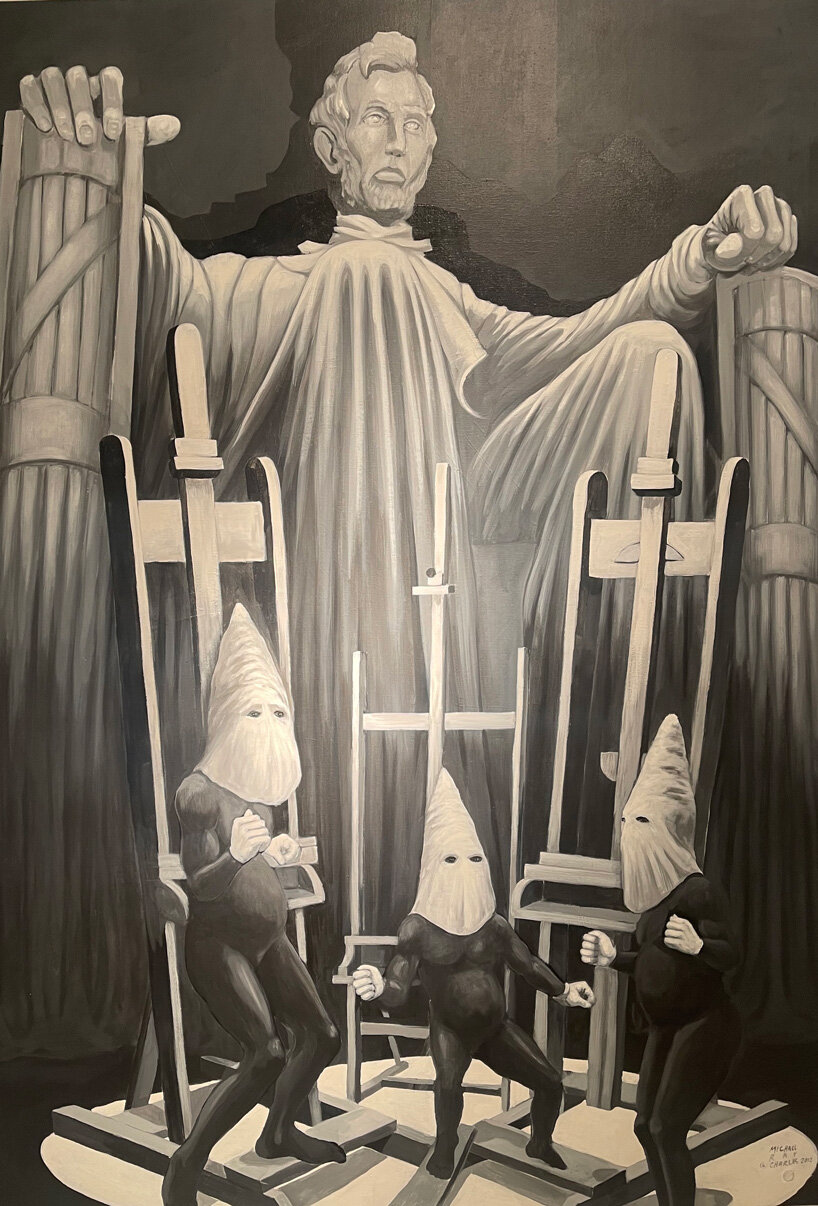
michael ray charles, (forever complimentary) the facts of live, 2012, paint, acrylic latex and copper penny on canvas, 195 × 140 cm — 76 × 55 1in.
all images courtesy templon / hedwig van impe © remei giralt
INTERVIEW WITH MICHAEL RAY CHARLES
designboom (DB): this is your outset exhibition in almost xx years. what made yous withdraw from the public sphere?
michael ray charles (MRC): I think early on, I gotten off to a fast start. and while I was property my own, I did accept some concerns most the speed and what I was putting out. I travel and requite lectures and talk about my work and along the way, I realised that america was non healed regarding notions or issues of race. often, people were looking at my work and their responses were less about the work, the work became a source for them to limited themselves. and I started thinking near why was that the issue? that led me to think virtually notions of power, and how people lacked power or had a certain range of power to express themselves in regards to certain ideas. oftentimes, black people were disturbed by the images, merely they talked about the images every bit if they were black people. and it varied with white people, their engagement with the work. also, the style that my work was being written about concerned me. or myself, for case, I was called 'a wild child from the southward', equally if I were wild and needed to be tamed or cultured by the due north. I felt people didn't talk most the piece of work enough, they didn't explore the imagery enough and it was more reactionary. the work had other challenges, don't get me wrong, but it was a moment for pause.
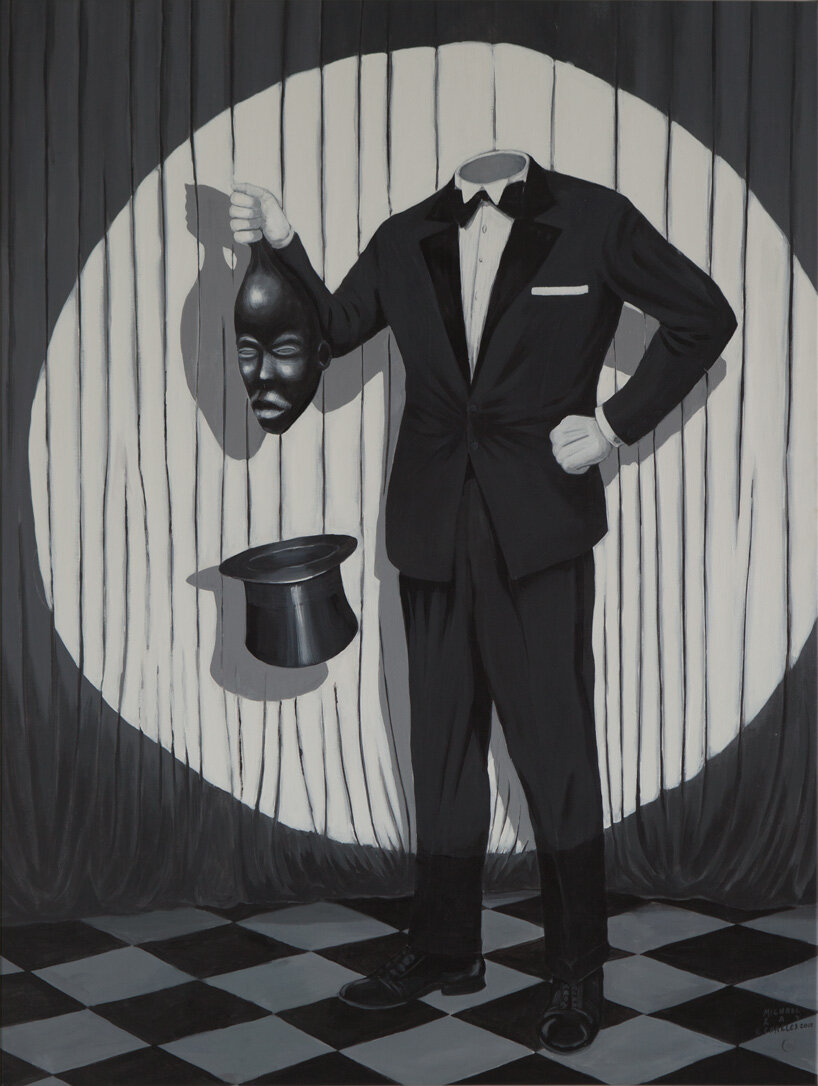
michael ray charles, (forever free) the magic man, 2012, acrylic latex and copper penny on canvas, 185 × 140 cm — 72 7/8 × 55 one/8 in. (also header paradigm)
DB: what made you decide to exhibit again now?
MRC: I had an opportunity to explore some culture hither in paris and in brussels, so I begun to embark on that. when I got here, I started to call back about being black in america versus being black in in europe and different parts of europe, and what that means. what were the similarities and differences? I was working with a business partner of mine, hedwig van impe, and we decided that it'd be a great idea just to produce piece of work. I would come abroad, I'd work here, and we'd travel. I was able to proceeds access to experiences and ideas most issues of race, power and history, and meet people that I would not otherwise have access to.
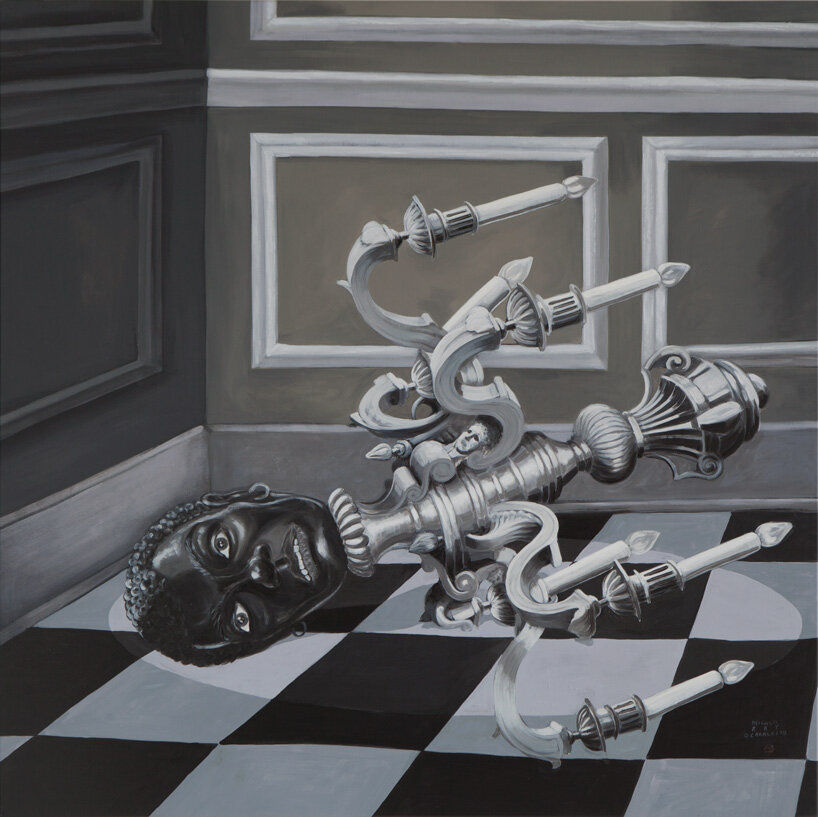
michael ray charles, (forever free) black values, 2013, acrylic latex and copper penny on canvas, 170 × 170 cm — 66 7/viii × 66 seven/eight in.
DB: do y'all think that the public'southward perception of your work, from 20 years ago to now, has changed in whatsoever way?
MRC: I don't know, obviously things have changed in 20 years. there'due south different ways that people appoint with the piece of work, folks come up to see the piece of work for dissimilar reasons. I'chiliad someone that believes that you are attracted to that which you are, as well. sometimes folks are interested in collecting piece of work for specific purposes. hopefully there's an aesthetic component that catches the attention of a person, and, hopefully, there's the feeling, the sensation, to question what one is seeing. all of those are of import to me. there's been consistency, and I call back that even if I was exhibiting more in that location would non have been much difference. there seems to exist a similar involvement.
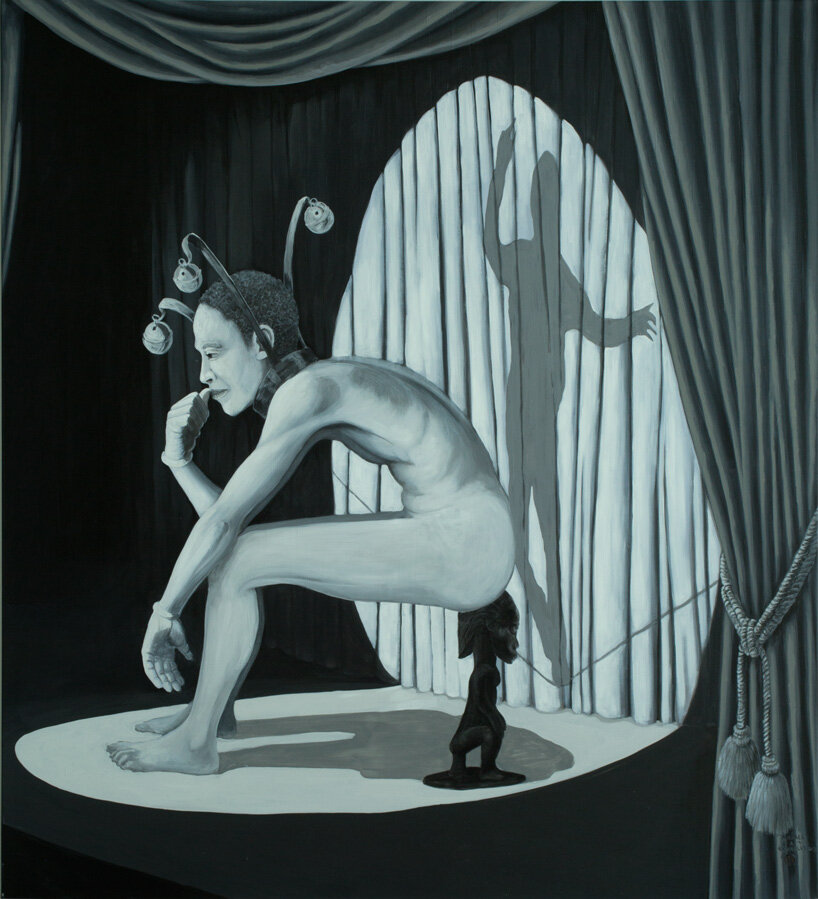
michael ray charles, (forever free) the road virtually travelled, 2013, acrylic latex and copper penny on canvas, 170 × 155 cm — 66 seven/8 × 61 in.
DB: you are showing new works, including paintings and sculptures, at galerie templon. do these part equally a continuation of your before work in terms of the themes they address or are there whatsoever additional topics?
MRC: I like to think that growth is linear. certainly I could brand paintings, adjacent to paintings, next to paintings and, and evidence the evolution of work. there's sure ideas that continue to linger, merely the before works were definitely informed past a different set of intentions. I made a conscious endeavour to make work that I thought reflect the characteristics of hip hop civilisation. I thought that there was a fourth dimension when blackness youth had the power to express themselves in an accurate fashion that was different than previous generations, and I wanted to not borrow from, but brand art of it. the best way was to make art that intersected with those characteristics. information technology was work that was unapologetic, it was in your face, it was confrontational, it was playful, it was clever at times, smart, I would even say brilliant, colourful. just I had always been interested in art serving other purposes than what typically people associate with information technology as something that sits on the wall and provides you with a moment of deviation. I'thou really interested in how the past remains present, and so I try to make art that encourages, or nurtures, the exploration of such ideas.
Source: https://www.designboom.com/art/racial-stereotypes-galerie-templon-interview-artist-michael-ray-charles-03-22-2022/
0 Response to "Post Your Reaction to the Artist Profile Video From the Online Lecture of Michael Ray Charles Art"
Post a Comment